
Arabic RTL Website Development for Qatar Businesses
Arabic RTL website development helps Qatar businesses serve customers clearly, manage bilingual content, and connect inquiries, bookings, and payments.
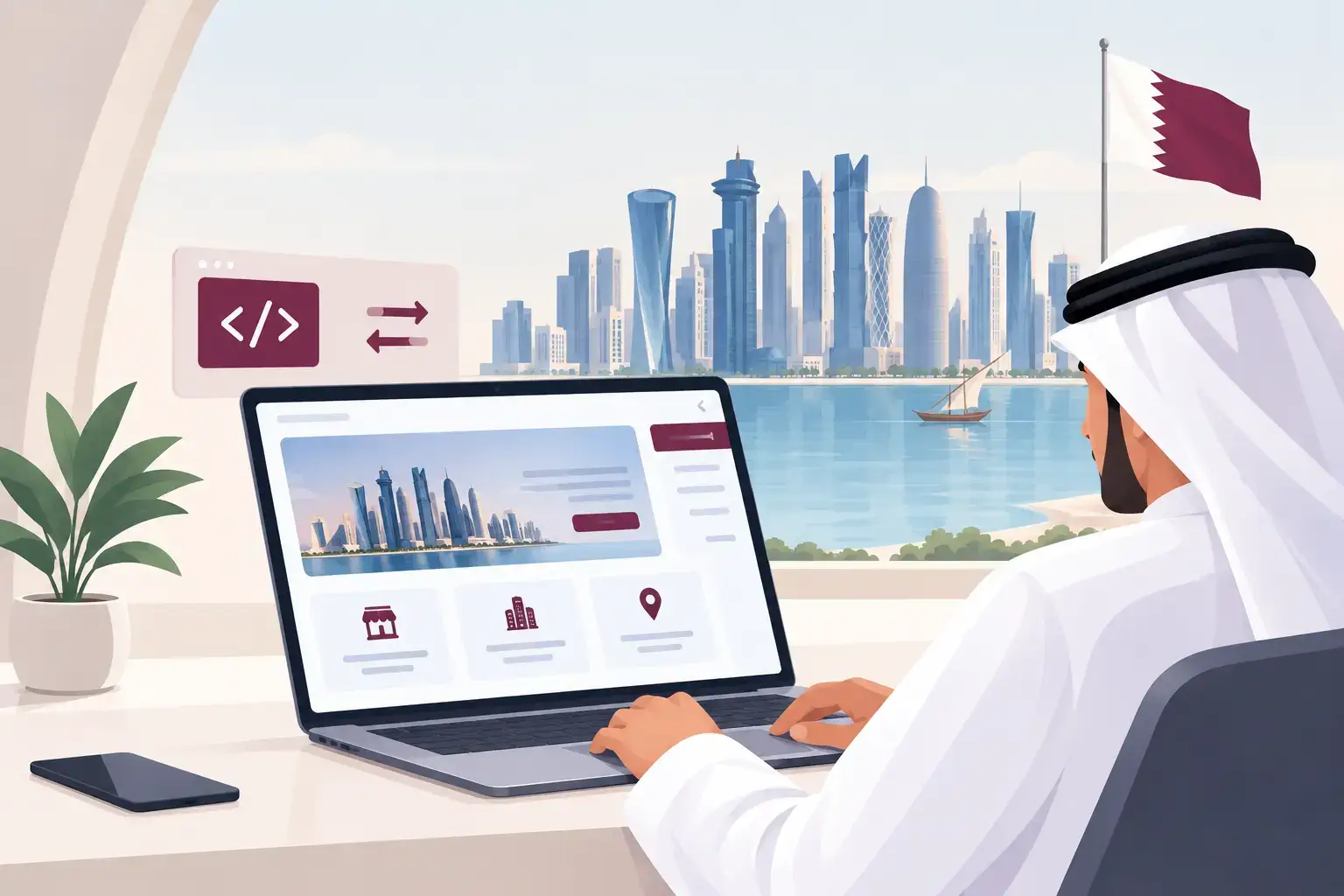
A customer in Doha finds your business on a phone, reads the Arabic homepage, sends an inquiry on WhatsApp, and expects a clear response without repeating their details. If the website feels like an English layout turned backward, confidence drops quickly. Arabic RTL website development is not a cosmetic adjustment. It is the work of making the Arabic customer journey feel considered from the first screen through to inquiries, bookings, payments, and follow-up.
For businesses serving Qatar's bilingual market, Arabic and English should be two complete experiences built around the same commercial goals. They may share content, systems, and brand standards, but they cannot be treated as one layout with translated text.
Why Arabic RTL website development needs a different approach
Right-to-left, or RTL, changes reading direction, visual hierarchy, navigation patterns, and the way users scan information. Arabic visitors generally begin at the right side of a page, so a call-to-action, menu, search field, or service card that works well in English may feel misplaced when simply mirrored.
The detail matters most on practical pages. A service business may need customers to request a quote, choose an appointment time, or share a location. A retailer may need shoppers to filter products, select options, review a cart, and complete payment. If labels are cut off, forms are difficult to complete, or Arabic and English numerals appear inconsistently, a customer may leave before the team ever sees the opportunity.
A well-built bilingual website therefore starts with customer actions rather than translation alone. What does a visitor need to understand? What should they do next? Where does the request go after they submit it? Those questions connect the front-end experience to the business process behind it.
Build Arabic and English around the same business journey
The best bilingual websites are consistent without being identical. Brand colors, service categories, trust signals, and core conversion paths should remain recognizable in both languages. The Arabic interface, however, needs its own RTL-aware structure and content review.
This is especially relevant when pages include mixed-direction content. Phone numbers, prices, dates, email addresses, URLs, vehicle model names, product codes, and technical specifications can behave unpredictably beside Arabic copy. The development team needs to control text direction at the field and component level, not just set the whole page to RTL.
Content also requires judgment. Direct translation can produce Arabic that is technically correct but unclear, overly formal, or too long for a button and navigation label. Navigation names, service descriptions, error messages, form prompts, and checkout instructions should be written for the space and action they support. A short English button such as “Get Started” may need a different Arabic phrase and width to remain clear.
For Qatar businesses, language selection should be easy to find and should preserve context wherever possible. If a visitor switches from English to Arabic while viewing a service, product, or article, taking them to the equivalent Arabic page is more useful than sending them back to the homepage. This sounds minor, but it prevents unnecessary friction for customers who are comparing information or sharing a page with colleagues and family.
Design the RTL interface before development begins
RTL support is most reliable when it is included in UX and UI design from the start. Retrofitting RTL after an English site is complete often creates avoidable compromises: uneven spacing, icons pointing the wrong way, awkward card alignment, and mobile menus that do not feel natural.
A design process should test both language directions across the pages that matter most. That usually includes the homepage, service or product pages, contact and inquiry forms, booking flows, account areas, checkout, confirmation screens, and customer emails or notifications.
Direction is more than moving text to the right
Some elements should mirror in Arabic, including navigation alignment, previous and next controls, carousel movement, form labels, and the placement of supporting icons. Other elements should not mirror automatically. Logos, maps, video controls, universal symbols, product imagery, and certain data tables may need individual treatment.
This is why automatic RTL plugins can be useful for a basic content site but are rarely sufficient for a business platform. A custom booking flow, marketplace, customer portal, or operational dashboard has more states, more data, and more exceptions. It needs deliberate component design.
Typography also deserves close attention. Arabic needs a typeface that is legible on smaller screens, supports the required characters, and suits the brand. Line height, letter spacing, font weight, and heading length all affect readability. An elegant English typeface pairing may not have an Arabic counterpart of the same quality, so this decision should happen early rather than after the visual system is approved.
Connect the website to the work your team actually does
A website creates value when it reduces the distance between customer intent and team action. For many organizations, that means an Arabic inquiry form should not end in a generic inbox. It should create or update a lead record, notify the right person, capture the source of the inquiry, and support timely follow-up.
The same principle applies to WhatsApp. Customers in Qatar often prefer messaging for quick questions, appointment requests, and service updates. A website can route Arabic and English inquiries into structured WhatsApp workflows, where the conversation is qualified, assigned, and tracked rather than left across individual staff phones.
A retailer may connect Arabic product pages to inventory, delivery rules, and payment processing. A home-care provider may connect a booking request to staff availability and customer records. A legal or professional services firm may connect consultation requests to intake forms, document collection, and internal assignment. The website is customer-facing, but it should be built around the operational system that follows.
This is where a single delivery team can make a meaningful difference. When strategy, design, development, integrations, testing, and support are handled together, the team can trace a customer action all the way to the dashboard or workflow that handles it. At OcttoApps, this approach helps turn bilingual websites into connected business tools rather than standalone marketing assets.
Test Arabic RTL website development where customers use it
Desktop review alone will not reveal the most costly problems. Many customers will visit from a mobile device, open a link from WhatsApp or Instagram, and decide within seconds whether the page feels trustworthy and easy to use.
Testing should cover common Arabic and English mobile scenarios: switching languages, using the menu, searching, selecting a date, entering a Qatar phone number, uploading a file, applying a product filter, submitting a form, receiving a confirmation, and returning through a shared link. If accounts, payments, or portals are involved, test the full path through login, notifications, and support requests as well.
Teams should also test real content rather than placeholder text. Arabic labels often take different space than English ones. Long service names, bilingual addresses, and mixed Arabic-English product information can expose layout issues that are invisible in a design demo.
Accessibility is part of quality, not a separate add-on. Form fields need clear labels, error messages must explain what needs correction, color should not be the only status indicator, and keyboard navigation should follow the correct RTL order. These choices help more people complete key actions and reduce avoidable support requests.
Plan for ongoing bilingual ownership
A bilingual site needs an operating model after launch. Someone needs to own Arabic and English content updates, approve new pages, check that promotions are active in both languages, and review inquiry handling. Without this discipline, one version eventually becomes outdated, incomplete, or commercially weaker.
The technical setup should make that ownership practical. Content editors need clear fields for each language, pages should have defined translation status, and reporting should show how Arabic and English visitors move through key journeys. Looking at inquiries, booking completions, cart abandonment, and response times by language can identify where the experience needs attention.
There are trade-offs. A simple bilingual corporate site can often be managed with a well-configured content platform and focused RTL design. A high-volume store, customer portal, or business system may justify custom components, deeper integrations, and ongoing release planning. The right scope depends on what customers need to do and what happens inside the business once they do it.
Start by mapping the few actions that matter most: requesting a quote, booking a service, buying a product, speaking to the team, or checking an existing request. Then make sure each one works naturally in Arabic, English, on mobile, and within the team workflow that comes next. That is how an RTL website becomes a dependable part of day-to-day growth.